Showing posts with label PET TRAINING. Show all posts

CLICKER TRAINING FOR BEGINNERS

CLICKER TRAINING

When introduced to clicker training, pet owners and handlers are often relieved by the apparent simplicity of the training. Watch for the behavior you want. Click when the behavior is occurring. Treat within one second.

Hands become stuck in pockets, treats drop, the clicker is moved from one hand to the other, we try to click and treat with the same hand….Sound familiar? If so, or if you’re new to clicker training and haven’t experienced this feeling of disarray, it’s time to learn the ‘mechanical’ skills that will make training run smoothly.

Learning these key skills will improve your ability to communicate clearly. Sharpening your timing of the click and the delivery of the reward will improve clarity and speed up learning. Just as learning any new skill, devoting the time necessary to teach your own body the ‘muscle memory’ it needs to act deliberately and with finesse, can turn one’s training from mediocre to outstanding.

One of the first considerations will be where and how to hold the clicker. Begin by deciding which hand you will use to hold the clicker. Consider where that will be held during training. Many trainers leave their clicking hand resting directly against their side. Some keep it hidden behind their back or resting above the belt line. This helps to limit movement, which can distract and confuse the animal. Work to eliminate inadvertent visual cues.

Once comfortable with where and how you’re holding the clicker, move on to honing observational skills. Begin by choosing what behavior you will mark, then watch the animal closely for any signs of the behavior occurring. Click as the behavior is occurring, not after it’s completed. This takes practice and a fine eye for detail.
Here’s how the sequence should flow: The moment the animal begins to offer the behavior you’re seeking, CLICK! The click acts as an event marker for the desired behavior and bridges the time between the behavior and the reward. Click only once for each correct behavior offered.

The click lets your animal know it has completed the task successfully and a reward is coming. If you make the mistake of inadvertently clicking, be sure to still follow with a treat or other reinforces. One click equals one treat. The rate of reward may be very high in the beginning and that’s fine (15- 20 clicks per minute). This is where practice becomes necessary.
It’s important that the rewards come predictably; within 1-2 seconds of the click. Be sure they are separate though. Vary the reinforcement (for dogs a mix of cheese, kibble, meat ends- for horses hay pellets, peppermints, carrot bits). And treat harder jobs with more valuable rewards. Dry kibble may work for some dogs some of the time, but often not when distracted or stressed. Be creative. Cheerio’s, cat kibble, cooked macaroni are low value rewards. When the task is mentally or physically challenging, try bits of cheese, chicken, hamburger, crumbled bacon or egg for higher value rewards. The smell alone is often enough to get your dog motivated!

You may now have a better understanding of the importance of manual dexterity, being a keen observer, and reinforcing predictably. The next consideration is ‘timing’. Good timing is crucial in clicker training. The opportune moment to treat is within 1-2 seconds of the click. Though the sequence may be rapid, it is also precise. Always remember, the click is distinctly separate from the treat. When practicing the click/treat sequence, keep your hands at home base (mine is right in front of my navel) and take care not to move your hands prematurely. This distracts the animal from the task at hand.


Do you have different  experience or tips?

SHARE WITH OUR READERS!!!!

Adiestramiento Canino Personalizado con PetsVentura


Este modelo de adiestramiento es el más recomendado. 

Consiste en veinte sesiones de una hora diaria, de lunes a viernes, a las que el cliente acude con su perro y trabaja con él, siguiendo las indicaciones del instructor. 

Al finalizar la clase, vuelve a casa con su mascota.

Es el recomendado porque se consiguen varios objetivos:

1. Acceder a los llamados ejercicios básicos: caminar a nuestro lado sin que tire de la correa, sentarse cuando paramos de caminar, sentarse a la orden y quedarse quieto hasta que le recoja, tumbarse a la orden y permanecer quieto hasta que le recoja, acudir a la llamada y sentarse delante del dueño.

2. Al ser el dueño el que realiza el trabajo de adiestramiento, se establece la jerarquía directamente, algo que es muy importante para la relación con su perro a lo largo de toda su vida, puesto que la jerarquía es la estructura social de los caninos. 

3. Incrementar la relación con el animal, ya que dedicándose veinte horas de tiempo solo para estar con él permite que esto se convierta en su mayor motivación. 

4. El dueño aprende a manejar las técnicas de obediencia pues practica como corregir las conductas no deseadas y cómo premiar a su perro por las conductas deseadas.


Contacte con nosotros


+5411 5292-6001 (Argentina)
+1818 627-6256

The Secrets of Communicating With Your Cat


You and your cat may talk different languages, but that doesn't mean that you can't talk with each other. While every cat is different, there is a common code of expression that you can learn to read easily.


Indicators such as the look in your cat's eyes, the tone of his voice, the position of her ears, and the motion of her tail can provide important clues regarding feelings and intentions. Some people feel silly speaking to cats, because they think animals can't understand them. GATO9
Yet these same people may feel comfortable carrying on long one-sided conversations with infants. Cats do receive information from your conversation: praise, comfort, and a sense of security.


The more cats are spoken to, the more they will speak back. You will learn a lot from your cat's wide vocabulary of chirps and meows. You will know when it is time to get up , when your cat is feeling affectionate, or when your cat is feeling threatened or is in pain.


Your cat doesn't necessarily have something urgent to tell you; a passing meow in the hallway may be a simple hello. You can also tell a great deal about what cats want or how they are feeling simply by the look in their eyes or their reaction to things.
Are your cat's ears twitching in your direction like satellite dishes when you are speaking? He is absorbing everything you are saying.

Consultant Canine


11dogsowners.18 As the Consultant Canine I teach you to live in perfect harmony with your dog. Every dog is unique and its well being and yours is my top priority.

Having studied dog psychology and with a life time’s experience of being around dogs, I use gentle, kind methods to help you train your dog and build a better understanding of canine behavior and language.


Dog Behavior,Training Basics - TIPS

The command voice
A reliable tone of voice is vital to exacting obedience from a dog. This tone may seem harsh or domineering to new dog owners, but the dog responds best to this kind of "bossiness". For more pleasure-oriented communications, such as praising the dog, feeding, or play, a higher-pitched tone of voice is useful, but for simple obedience, the human equivalent of a bark seems to work best. 

In all training and discipline, the dog's name is an important command component. In early training, most commands are prefaced with the name: Fido come is more powerful to a young dog of that name than a simple Come. After the dog is trained, the name need not be used every time, but when used; the name always adds emphasis to the command.
dog walker_Argentina_Petsventura
Basic Commands
Here are a few commands that almost every dog should respond to:
  • Come: This command, also referred to as the recall, is important. If the dog won't come when called, it is not an obedient dog. One method for training begins by allowing the dog to walk out on a long leash or line, then calling it by name and the command Come. This method might need a quick, light tug on the leash to get the dog moving when first teaching this command. Like all commands, it is successful only if the dog is rewarded when it completes the command and only if the practice is repeated-under different situation and distances and gradually removing the controls-until the dog performs flawlessly.
  • Sit: This command is also crucial. Sitting dogs are under the handler's direct control. It is common to precede other commands, such as the Stay command, with a sit command. One method for training uses a treat held in front of the dog's nose and passed back over its head, forcing the dog to sit. Sit and Stay are used in combination with many other commands.
  • Stay: This command gives peace of mind. An owner can park her dog while doing something else. One method of training involves placing the dog in a sit or a down position, then telling it to stay while stepping away from the dog. If the dog stays, the handler rewards it while it is still in the position.
  • Lie down or down: this command allows even superior control than sitting. One training method uses a treat drawn forward and down across the dog's face, forcing it to lie down to get at it. Since even people without dogs are familiar with this command and use it when dogs are bothering them, the better the dog is at it, the better it can get along strangers and visitors.
  • Go to .. or get in: Directs the dog to go to its bed or into its crate and to remain there until released. The dog has freedom of movement in that location to stand up, turn around, or lie down, unlike when placed in a Stay. This command is useful to keep a dog out from underfoot and safe in a busy or complicated situation.
  • Drop or drop it: Dogs pick up all sorts of things, some of which they shouldn't have. A dog that drops anything on command, no matter how attractive, is a dog under control that the owner can prevent from eating dangerous items or from destroying valued personal property.
  • Leave it: An adjunct to Drop, directing the dog to not touch an item. Also useful before the dog has picked anything up. One method of training involves leaving a treat on the ground and walking the dog past it without allowing the dog to pick it up. Leave it is also used in conjunction with Take it.
  • Take it: The dog leaves a desired object, such as a toy or treat, untouched until given this command. This can protect an owner's, or child's fingers.
  • Heel: The dog walks with its head directly next to the master's leg and does not deviate until released. One method of training accompanies the command with a slap to the thigh indicating where the handler wants the dog's head.
  • Okay, Free, or Release: Releases the dog from Stay, Heel, Sit, and so forth. Also a general release to play.
The specific command word is not important, although the preceding list covers some of the more common words. Short, clear words that are easily understood by other humans are generally recommended; that way, people will understand what a master is telling his dog to do and other masters have a good chance of controlling someone else's dog if necessary. In fact, dogs can learn commands in any language or other communications medium, including whistles, mouth sounds, hand gestures, and so forth.
While dogs can be trained far beyond these rudiments, a dog that obeys these commands will be a pleasure to keep and take out. Off-leash obedience is the trademark of a well-trained dog.
    To arrange your appointment with our pet trainer specialist:
Phones:


+54 (11) 4836-2290  (Argentina)
+1 ( 818) 627-6256 (USA)

Stop Your Dog From Barking

    Most dogs have no indication as to whether barking is something good or something bad. Dogs have a natural instinct to protector what they believe is their territory. They consider it their obligation to notify other pack members (which include you and your family) of intruders. Without a doubt many people value their dog’s capacity to warn them of people entering their premises. However this dog barking can often be excessive and become a irritant to you and your neighbors.

    There are different methods to handle excessive dog barking:

  • Barking is OK until the dog is told to "Stop Barking." Each time your dog barks, after two or three barking, praise your dog for sounding the alarm. Then order your dog, "Stop Barking." At the same time, you can provide your dog especially tasty food treat in front of its nose. Praise her continuously "Good girl, stop barking, what a good quiet dog you are, good dog . . ." After 3 seconds of no barking, let her have the treat. The next time she barks, require her to stop barking for 5 seconds before she gets the treat. Each time she is told to stop barking and succeeds, she will be rewarded. Within a single training session, you can teach your dog to stop barking for up to 1 or 2 minutes. This is major progress, because whatever set off her barking in the first place is history, and she is likely to be quiet until the next disturbance.

  • Sometimes a spray of water in the face will do the trick. You must find something that will immediately make your dog stop barking. As soon as your dog stops barking, even for just a tenth of a second, you must immediately and instantly reward her. After adequate repetitions your dog will learn the meaning of the command, "Stop Barking," and you will no longer need your training props (water, treats, etc.)

    Last Ones 01-04 021

If your dog's excessive barking has already become a routine, don't expect the barking to get under control at once. It takes weeks of repetition to replace an old habit with a new one. Instead of barking relentlessly at the insignificant, your dog will be barking appropriately and for a logical length of time. It is important that you maintain this new good habit through practice and praise or your dog may revive his old annoying barking habits again.

Cruise Across The Ocean With Your Pet

No longer is there any need to leave your fabulous feline or perky pooch behind. Cunard's ship, the Queen Mary 2, now has a full time Kennel Master to oversee the various needs and desires of your favorite pet. Presently, the ship boasts a dozen spacious kennels. These kennels are available on all crossings between New York and Southampton in either direction. New pet-friendly services and amenities were added in 2006 (such as fresh-baked gourmet biscuits at turn down, a variety of comfortable beds and blankets, and a lovely travel coat, complete with a QM2 logo).cunard_qm2_2

Traveling dogs and cats also receive a complimentary gift pack, including:       

  • Frisbee
  • Personalized name tag
  • Food dish and scoop
  • Fashionable portrait with pet owners
  • A transatlantic crossing certificate
  • Personalized cruise card

Additional perks include:   

  • Divinely comfortable pet beds in two sizes
  • Healthy gourmet cookies for dogs and cats baked fresh daily and offered at bedtime
  • Comfortable fleece blankets
  • An assortment of dog and cat toys
  • Cat posts and scratchers
  • A selection of premium pet foods from recognized top brands

STOP SUBMISSIVE URINATION IN DOGS


  • Warmly compliment your dog for positive behavior such as going outside to urinate
  • Greet your dog calmly from a standing position. When you bend down and your dog lies down to say hi, he will be showing more submissive behavior which reinforces other behaviors of this nature such as submissive urination.
  • Avoid direct eye to eye contact when you first see your dog upon returning home. This can be intimidating to a timid pooch and precipitate submissive behavior.
  • Don’t grab and hug your dog when you walk into a room where submissive urination has occurred. Once again, a shy pup may see this as an act of dominance and the result will be submissive urination.
  • If submissive urination occurs at a specific time, such as before sleeping, or just before you go out, try limiting your dog’s water drinking at that time. Be careful not to deprive your dog’s water access for more than just a very short period of time as water is essential to his well being.
  • Don’t make a big deal out of your return home. The excitement in your voice and greeting can be a signal to your dog that he should submit to your entrance and respond with submissive urination. Enter the room calmly and without fanfare. Just let your dog come to you. He will relax once he knows this is not a time for him to respond to dominant behavior by submissive urination
  • Join a group dog training class. Submissive urination is not a house training issue. By helping your develop other behaviors such as responding to basic commands of sit, stay, come, fetch and others you will be reinforcing positive behaviors and can then divert your dog from submissive urination when that moment occurs.
  • Never scold or punish your dog who is displaying submissive urination behavior. This will only reinforce the behavior and in the case of punishment can be inhumane and unlawful as well.  Just say “NO”, in the popular vernacular of many anti drug use advocates. Do this in a firm but calm voice each time.

113_1310

PUPPY POTTY TRAINING TIPS

Puppy Potty Training is probably the first thing that most people have with puppy training. It is important that you get this vital first step right.


First, decide whether you will potty train your puppy to go outside or inside. Pick a command that you will use every time he goes potty. It can be “pee pee time,” or “go potty,” or what ever you choose. When you see your puppy getting ready to do his thing, say the command words. Say the command with joy and excitement, letting your puppy knows how proud you are of him. Repeat the command even while he is going.
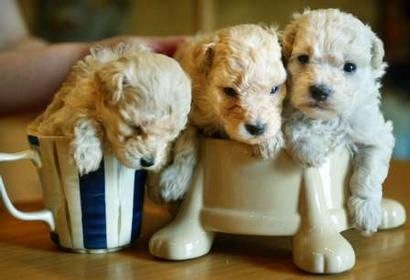
tea cup dog 
If you are fortunate enough to have a yard, potty training poppies outdoors is great. Try to take him to the same spot every time. The scent of his past performances will help him to go quickly. 

Try to keep his walks on regular schedules and always use the command words and lots of praise.

The biggest challenge when potty training puppies not to go in the house is teaching him to hold it. You don’t want to come home to little surprises, so if you don’t have a fenced yard, you will benefit from crate training. Like people, poppies are very unlikely to make potty in their private quarters. 

A crate teaches him to hold on. You must use good timing and be sure to watch the schedule because it would be cruel to leave him in a crate longer than he can hold it. You want the crate to be warm and comfortable so your puppy will want to use it. At first try to leave the door open so that your puppy doesn’t feel trapped.

Then begin leaving the door closed for short times while you are home, and give him lots of praise for behaving so well. Slowly increase the amount of time you leave him in, and soon he will be comfortable staying in the crate for longer periods of time. And finally do not use the crate for punishment or your puppy will not be able to adjust to it as easily.

Puppy potty training tips for indoor puppy potty training.

It is important to remember when puppy potty training, that puppies do not have full control of their potty urges until they are about 10 weeks old, so you want to keep them confined in a fenced off area in your kitchen or bathroom with lots of newspapers on the floor. Also remember that puppies need to eat and drink more than grown poppies, so it is natural that they will need to go potty more.

After 10 weeks old find an area in your home that the puppy will always go when nature calls, away from his food or bedding. Find a shallow tub and fill it with torn newspapers and keep it clean. A good tip is to keep a soiled piece of paper and put it in with the clean paper to give it that scent to attract him to his potty.

All poppies do similar things when they have to go potty. If you catch him sniffing around or circling or even catch him in the act, grab him and quickly take him to his potty. Give your command words to go potty when you put him in his potty box. Praise him as he goes, repeating your command words.

Other than circling around nervously remember to put him in his potty box after exercise or play, about 30 minutes after eating or playing, or when your puppy wakes up from a nap. Another important puppy potty training tip, is to check your puppy’s paws after he is through to be sure that he didn’t walk in his waste. Be sure to use lots of praise when your puppy uses his potty, even when he misses and makes a mess. Your puppy or puppy needs to understand that his potty is for elimination not for an act of misbehavior.

For more information or advice contact PetsVentura® professionals to assist you in training your puppy: 

TEL: clip_image001[6]+54 (11) 4836-2290

CRATE TRAINNING YOUR PUPPY

Crate train your puppy early as it will benefit both the puppy and its owner. The puppy will use the crate as its home or bed for rest and security, if trained properly.

It could also assist you in your potty training too.

115_1532 hunter5

Why a dog crate?

A crate will be taken as a comfortable and secured home for your puppy if you crate train it properly.  It would not soil it since it is going to rest and sleep there, and you can also use it to potty train your dog too.

Introduce the puppy into the crate by luring it in with some toy or a treat or, worst case; just carry the little cute puppy into it. You can place an old T-shirt or towel to make it more comfortable for it to rest and sleep.

You should only put the puppy into the crate when it sleeps at night and it would slowly learn to go into it for nap during the day. Or when it feels frighten in certain circumstances like heavy rain with thunder and lightning.

Eventually, it will learn that the crate is its home and a place to go to for rest and sleep, and a place where it feels secure.

The crate can also be useful if it is an indoor dog and you need to leave it alone in the house or apartment when you go out for a short while.

So what is a dog crate?

A dog crate can be a foldable metallic fence, plastic dog house, collapsible plastic or foldable portable nylon mesh crate. I would recommend that you get a big size plastic crate with a metallic door; one that can have the top half removed.

There are different sizes of crates to suit the different breeds of dogs. Your dog must be able to sit upright inside the crate and lie down comfortably across the crate. It must be able to turn around inside the crate. I would suggest that you buy the size that would fit your puppy when it has grown into an adult dog.

The crate should not be used for confinement as a punishment for some wrongdoing. For example , it should not be used to punish your dog when it does not listen to your commands during training.

SEPARATION ANXIETY IN DOGS

What is separation anxiety?

 A dog with separation anxiety becomes abnormally anxious when separated from his owner. The severity of the anxiety and behavior the dog exhibits varies from animal to animal. Separation anxiety can result in problematic behaviors such as: whining, pacing, salivation, barking, howling, scratching, chewing, digging, urinating or defecating, or destroying personal items or household objects.


What can I do about separation anxiety?

 If you suspect your dog is suffering from severe separation anxiety - especially if he is harming himself or your property - please consult with us to find the best method of treatment. Quite often leaving a radio on will help ease the dog and drown out ‘strange’ sounds. For milder cases, you may want to try one or more of the following tips to help reduce your dog's anxiety: More exercise - Go for more walks and throw the ball more often. Tired dogs are naturally less anxious. Soften your departures & returns - Keep your departures and returns low-keyed and unexciting. Don’t speak to the dog when you leave and don’t go nuts over him when you return! Gradually lengthen periods of your absence - Stage several short departures/arrivals throughout the day, gradually lengthening each absence as your dog adjusts. Finally, try the Pheromone Plug-In - Many dog owners have seen a remarkable improvement in their dog's anxiety with a relatively new product, the Comfort Zone Plug-In. Inserted in any wall outlet, and odourless to humans, it releases Dog Appeasing Pheromones (DAPs) in the air throughout the entire room. Mimicking a mother dog’s natural pheromones, it reduces and prevents stress-related behavior such as barking, whining, chewing, and soiling.

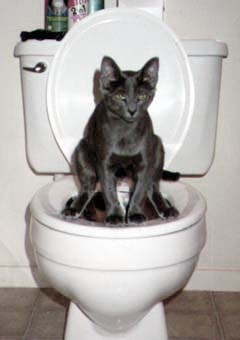
TOILET-TRAIN YOUR CAT

Begin by moving the cat's current litter box from wherever it is to one side of the toilet. Make sure he knows where it is and uses it. Next put something — a stack of newspapers, a phone book, a cardboard box — under the litter box to raise it, say, about an inch. Get another box or phone book and raise it a little higher. Continue this process until the bottom of the litter box is level with the top of the toilet seatclip_image001

At the beginning of this process, your cat could just step into the box; later he began jumping up into it, until at some point he probably started jumping up onto the toilet seat first and stepping into the box from there. You've been diligently keeping the lid up and the seat down, of course, so by now your cat is thoroughly familiar with tromping around on the open toilet.

Lift the seat on your toilet and measure the inside diameter of the top of the bowl at its widest point. Venture forth and buy a metal mixing bowl of that diameter. Do not substitute a plastic bowl. A plastic bowl will not support the cat's weight and will bend, dropping into the toilet bowl and spilling litter everywhere, not to mention startling hell out of the cat.

Now you move the litter box over so that it's sitting directly over the toilet seat. Take away the stack of phone books or whatever.

Take away the litter box entirely. Nestle the metal mixing bowl inside the toilet bowl and lower the seat. Fill the bowl with about two inches of litter

Naturally, any humans using the toilet at this point will want to remove the metal bowl prior to their own use and replace it afterward. The next week or two the whole process is likely to be something of an annoyance; if you begin to think it's not worth it, just remember that you will never have to clean a litter box again.

Watch your cat using the bathroom in the metal bowl. Count the number of feet he gets up on the toilet seat.

Catch him beginning to use the toilet as much of the time as possible and show him where his feet are supposed to go. Just lift them right out of the bowl and place them on the seat. If he starts out with three or, heaven forbid, all four feet in the bowl, just get the front two feet out first. Praise him all over the place every time he completes the activity in this position.

When he is regularly using the toilet with his front feet, begin lifting a hind foot out and placing it on the seat outside the front paws. Be persistent. Move that foot four times in a row if you have to, until it stays there. Praise and/or treat.


Repeat with the other hind foot, until your cat learns to balance in that squat. Once he's getting all four feet regularly on the seat, it's all downhill from here.

Begin reducing the litter in the bowl. Go as fast as he'll feel comfortable with, because as the litter decreases, the odor increases. You'll want to be home at this point so that you can praise him and dump out the contents of the bowl immediately after he's finished, to minimize both the smell and the possibility that your cat, in a confused attempt to minimize the smell on his own, tries to cover it up with litter that no longer exists and ends up tracking unpleasantness into the rest of the house.

By the time you're down to a token teaspoonful of litter in the bottom of the bowl, your next-door neighbors will probably be aware of the precise instant your cat has used the toilet. This is as bad as it gets. The next time you rinse out the metal bowl, put a little bit of water in the bottom. Increase the water level each time, just as you decreased the litter level

Once the water in the mixing bowl is a couple of inches deep and your cat is comfortable with the whole thing, you get to perform the last bit of magic. Take the mixing bowl away, leaving the bare toilet.

HOW TO HELP YOUR DOGS TO COPE WITH FIREWORKS


  1. Stay at home with your dog or drive it to the countryside and return when the fireworks have finished.
  2. Keep your dog indoors. Avoid late afternoon and evening walks. Try to give the last chance for a pee after the fireworks have stopped.
  3. Close windows to reduce the bangs and shut curtains and keep bright lights on so that associated flashes can't be seen.
  4. Play loud music with a beat to reduce the impact of any bangs that occur outside.
  5. Try to keep your dog relaxed by playing with toys before the fireworks start and keep playing throughout.
  6. Don't reassure your dog if it looks apprehensive or frightened because this will accidentally increase its fear by giving it attention when it is a state of distress.
  7. If your dog is in a relaxed state when fireworks occur give it attention to reward it.
  8. Ignore fireworks yourself.
  9. Maintain your dog's access to any area it has already learn to go to as a means of coping.
  10. Don't move your dog if it is sheltering somewhere because you could cause it to become defensive.
  11. Pray for rain.


We have treatment of behavioral problems in dogs and cats. Owners of pets, whose behavior is causing concern, can consult with one of PETSVENTURA specialist behavioral. Consultations are held on a one-to-one basis, normally lasting 1½ to 2hrs and involve the practitioner, the pet and the pet’s family. The consultation may produce results very quickly, but often it will take time, effort and a commitment by all the family to work at it, to produce the improved behavior. Problems include all forms of aggression, separation problems, destructiveness, self mutilation, vocal behavior, toileting problems, marking, spraying, car travel, nervousness and more.


Contact us by phone: +54 (11) 4836-2290 or by Email.

TRAIN YOUR DOG TO STAY


Step1
Be sure your dog understands a release command, such as "free" or "okay," before teaching this command.

Step2
Have your dog sit or lie down in front of you.

Step3
Place your hand, palm open, in front of your dog's nose and give the command "Stay."

Step4
Say "Good" at the exact moment your dog exhibits the behavior you want.

Step5
Give the release command immediately after (within 1 to 2 seconds), followed by treats and unlimited praise.

Step6
Reward your pet even if she only "stayed" for 1 second; and always offer rewards for even slight indications of understanding.

Step7
Lengthen the amount of time your pet remains in the stay position very gradually and slowly move farther away.

Step8
Remember to give the release command after every successful "stay" as you increase the length of time your dog must remain in the position.

Step9
Avoid going into another room until your dog fully understands the command.

Step10
Train in 5-minute sessions.


Good Luck,

Be a Responsible Pet Owner ... and Have Fun with your Friend!

Get in touch with the PetsVentura ® to assist you in all your pet training issues.. Jim Anderson is a specialist in animal behavior and will assist you with your dilemmas. For further information please contact us by phone: 5411-4836-2290 or by email. http://www.petsventura.com/ and http://petsventura.blogspot.com/

DO DOGS SPEAK?


Communication in a dog’s language includes the use of sound (i.e. barking), body language (movement and facial expressions). The sounds dogs make, or the movements and/or gestures made with their face and/or body express their feelings, the same way people might do, although human and animal expressions can completely differ in the meanings attached to them.

Dogs learn to respond to different sounds, body language (movements and gestures) and facial expressions. Animals instinctively communicate with other dogs and this is not something they learn from humans. So, a dog from Argentina will understand a dog from England, and so on. They will, however, have difficulty understanding the English or Spanish spoken language, or any other language, since every language has different sounds associated with the words in the language.

As a dog trainer for the last 35 years, I have not encountered difficulty in communicating with dogs, including dogs coming from other countries where the spoken language has been different than my own. Based on both my knowledge and experience with dog training as well as in linguistic professional, I can confidently say that I a dog’s level of understanding is based on our ability to learn how to communicate in their language by using our own voice, body language (movements) and facial expressions.

More you can read about this interesting topic here:

http://dsc.discovery.com/news/2006/12/06/dogbarks_ani.html?category=animals&guid=20061206093000/
Reblog this post [with Zemanta]
Related Posts Plugin for WordPress, Blogger...