Showing posts with label TRAVEL WITH CATS. Show all posts

Pet in cargo hold

When you send your pet by cargo flight you might wounder where the kennel is placed at the airplane. 

I attached to this short note a picture to demonstrate the place in cargo hold. All kennels are secured in an area designated for live an
imals, away from the other baggage and cargo. Kennels are either strapped down individually or otherwise secured with tarp or netting.


The air in the cargo hold is the exact same pressurized, temperature-controlled air that circulates throughout the main cabin. But because the multitude of human bodies sitting together generates added warmth in the more insulated main cabin, the air is always cooler in cargo. To remedy this, most aircrafts have a “high/low” switch in the cockpit that sends additional warm air to cargo, which the pilot sets to “high” whenever there are live animals below. One pilot states that on a Boeing 777, the cargo air averages about 18°C (64.4° F) with the switch set to high, but can drop to below 10 °C (50°F) if mistakenly left on the low setting.

To help prevent such an accident, all pilots are informed on their load manifest when there are live animals “in the pit.” For caution’s sake, it would be wise to ask your flight attendant to confirm the pilot has “flipped the switch” and is aware of your precious cargo below!

PetsVentura Pet Relocation Solutions can assist you with all your questions regards to travel with pets.


International Pet Relocation Quotes


When you and your family decide to move with your pet/s, PetsVentura Pet Relocation Solutions ® know how stressful it can be to arrange all the logistics and with pets, it is even more distressing. This is where we step in. We take on all the logistics involved with relocating your pets, as there are often many steps involved, and we handle it all for you.

PetsVentura Pet Relocation Solutions ®  will asses, which paperwork is needed for the country you are moving to, and we will get in touch with agents on that side, if necessary. We will obtain the health certificate in due time (each country has a different time stipulation). We will find the safest and fastest flight plan for your pets, so that they have to endure as little stress as possible. We will also always seek the most economical flight schedule, when possible. We make sure the travel box sizes are appropriate according to IATA regulations, in order for the pets to have enough room for travelling and to secure that there will be no hold–ups during travelling.

PetsVentura Pet Relocation Solutions ® will collect the travel kennel in advance, so we may prepare them before your pet needs to travel, making sure all the necessary paperwork is attached securely and that your pet can travel safe and with as much comfort ability as possible.

Your PetsVentura Pet Relocation Solutions ® agent will personally take your pets to the airport to check them in for their flight. The same   agent will further follow your pet’s progress on their journey to their final destination, will give you updates and we do not stop chasing and we do not “close” until we know for certain, that the kids are happily reunited with their family.

To provide you a quote, please provide the following details:

- Pet details including health status
- Estimated departure date
- Size of travel box (height, width and length)
- Final destination point
- Weight of pet in the travel box with a blanket
- Vaccination status


We will provide you with a quote in within 72 hours and we will advise you on your options of how to proceed.
PetsVentura Pet Relocation Solutions ® understand the anxieties, that you may have and that your pet might incur and we are here to assist you and yours in any way we can. Just contact us with your questions, and we will get back to you immediately to help you.


PetsVentura Pet Relocation Solutions ® will provide as much or as little aid, as your relocation may require and only charge you accordingly.
We think it is fantastic and we are truly thankful, when families who have decided on relocating, naturally include their family pet /s.


Click on the logo to get a quote:

TRASLADOS DE MASCOTAS


El traslado de sus bienes, podría incluir a miembros muy especiales: sus mascotas. Por eso PetsVentura Pet Relocation Solutions (www.petsventura.com ) ofrece un servicio especializado para su transporte, que incluye no sólo los trámites esenciales para su retiro del país, sino también la selección del medio de transporte y de jaulas diseñadas para tal fin.


Transporte de mascotas a todo el Mundo

Transporte de mascotas a todo el Mundo, hacemos traslado de animales vivos en todo el interior del Pais, gestionamos tramites como lazaretos, consulados, senasa.


Disponemos de mas de 8 modelos de cajas y jaulas transportadoras para perros y gatos en venta , bebederos de goteo aprobados por I.A.T.A, homologados por la Union Europea.


Tambien contamos con nuestro servicio de pensionado canino y felino durante todo el año.


Para mayor información puede contactarnos por:


Costa Rica Import Permit

Most of the government offices in Costa Rica close for the week between Christmas and New Years and many take an extended vacation beginning the 18th of December and not ending until after the 3rd of January.


If you are trying to import a pet you will find that this rule applies to you and the offices that you need to be opened to facilitate your need for an import permit. While some offices will be opened on a skeleton crew they will not be issuing import permits during this time and will only resume this practice after the 3rd of January.


Pets can still leave the country but should not try to enter the country by the proper means or they risk being held by the customs officials for an unlimited period of time.

Short-Nosed Dogs and Air Travel


In July 2010, the U.S. Department of Transportation released statistics that showed short-nosed breeds of dogs—such as pugs, Boston Terriers, boxers, mastiffs, Pekingese, Lhasa Apsos, Shih Tzus and bulldogs—are more likely to die on airplanes than dogs with normal-length muzzles.


 In fact, over the last 5 years, approximately one-half of the 122 dog deaths associated with airline flights involved these short-faced breeds. 25 of the 122 dogs that died over the 5-year period were English bulldogs, followed by 11 pugs, the only other breed in double digits. Although these numbers seem a bit scary, keep in mind that this is a very small number when compared to the hundreds of thousands of animals that fly every year.

As a result of the tighter space, they are prone to problems such as smaller-than-normal nostrils, a longer-than-normal soft palate, and a narrowed trachea (or windpipe).

Because of these abnormalities, they don't breathe as efficiently as dogs with normal-length snouts and can have difficulty cooling off when they're playing or exercising, or if they're stressed or overheated. And when they're stressed, their airway can actually collapse (either partially or completely) and cut off their airflow.

It's like breathing through a straw – if you gently suck through the straw, there's no problem getting air. But when you really try to suck hard through the straw, similar to what these dogs may do when they're stressed, exercising or overheating, the straw collapses and you don't get air. This doesn't always cause death, but it can cut off their oxygen supply temporarily and cause the dogs to collapse or overheat.

Travelling in Europe with a Pet


Traveling with a cat or dog is now much easier with the new EU pet passport
The requirements:
Traveling with a cat or dog is now much easier with the new EU pet passport available from any veterinarian in Europe. The national authorities in every EU country are responsible for issuing the passport to the vets . All cats and dogs must have a passport containing details of a valid rabies vaccination. Until the end of 2011, Ireland, Malta, Sweden and the United Kingdom also require proof that the vaccination has been effective.
Pet_Passport

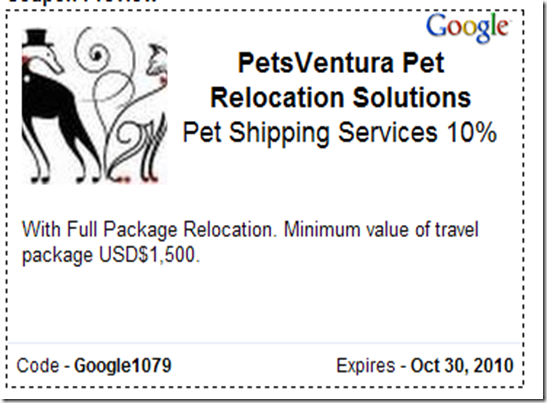
Limited Time Promotion Pet Relocation Coupon

Promotion Coupon

FLIGHT TRACKING

Do you want to take your family Pet away with you?Do you ship your pet by Cargo?

Tracking the status of your pet shipping can be done by using real-time system

Flight Tracking


Driving With Dogs Can Be Dangerous

About two-thirds of dog owners surveyed by the AAA organization said they routinely drive while petting or playing with their dogs, sometimes even giving them food or water while maneuvering through traffic.
It has been a common sight for many years to see dogs hanging their heads out of open car windows with their ears flapping in the breeze. But in the cocoon that the automobile has become, more drivers are nonchalantly cradling their dogs atop their laps or perching the animals on their chests with the pet's front paws clutching the driver's neck or shoulders.

Taking the Buquebus Ferry from Buenos Aires, Argentina to Uruguay with your pets


PETS: DOGS CATS AND BIRDS


Buquebus (BOO-kay-boos) is the name of company which operates ferry services from Montevideo and Colonia to Buenos Aires.

Buquebus ferries run daily between Buenos Aires and two Uruguay destinations: Colonia and Montevideo. Colonia is a small historic town with cobblestone streets and restored buildings. Montevideo is the capital of Uruguay. The trip between Buenos Aires and Colonia takes 3 hours on the regular ferry or just 1 hour on the fast ferry. The trip to Montevideo takes 3 hours on the fast ferry

PETC (pet in cabin), it is allowed one per trip, which also does not exceed 6kgs including the kennel. Kennel measures: it should be of rigid material, with ventilation, impermeable base and its measures: 45x35x25 

The company does not provide the kennel. Pet`s bag will not be accepted!
Guided dogs: They travel in the cabin without the kennel and they travel freely, showing previously the training and vaccination certificate 

Important: all the animals have to present document of sales reservation, health certification, issued by the competent authority of each country.


Picture0002

How to avoid quarantine when travelling with a pet

How safe is it to ship my pet by air?

A letter written by Senators Robert Menendez (D-N.J.), Richard Durbin (D-Ill.) and Joseph Lieberman (I-Conn.) calling on Secretary of Transportation Ray LaHood to review current regulations concerning the reporting of animal deaths on commercial airlines:

"While concerns about the reporting of pet fatalities voiced by Senators Menendez, Durbin and Lieberman are valid, changing the way airlines report the deaths of pets will not save lives in the long run."

"Our national focus should be on proactive ways to make pet travel safer and acknowledging that professional pet travel companies help pet owners avoid tragic mistakes, like using crates that are not adequately ventilated or booking pets on airlines that are not able to safely accommodate animals."

A special compartment in the cargo section, designed for Live Animals It is fully pressurized and same temperature as the passenger cabin.  This area is VERY carefully monitored by the Captain and staff.  

Yes, it does have some noise..

Pet owners can minimize these risks.  

Major problems resulting in death or serious health issues result from: brachycephalic breeds of cats and dogs; and having the brachycephalic respiratory syndrome.  Also, elderly pets.  And, those having congenital or pre-existing health issues.  These pets often have pre-existing heart disease resulting in pulmonary congestion and edema.  Then, if a death occurs, one is often inclined to blame the airline. 

Kennel construction is most often the problem with escapes, etc.  Many kennels have very poor connection devices.

Many pet injuries occur when some pets scratch and try to escape.  Pet shippers and airlines can NOT be  responsible for highly agitated pets.  If you have a pet that meets any of the above criteria as being a risk factor, just do NOT ship these pets.

Most reputable pet transportation companies are members of a group called the Independent Pet and Animal Transportation Association (IPATA). The association regulates and monitors the pet transportation industry by setting ethics standards and overseeing the performance of their members. As part of their membership, pet shipping companies are given access to a network of pet transportation professionals globally who have guaranteed reputations for the services they provide.

How many pet owners are willing to use the services given by  reputable IPATA members? 

Due to IPATA's exacting standards for membership, affiliates are able to safely coordinate this specialized service for the most precious of cargo. As a way of bridging the gap often found in an international industry, IPATA also offers an annual conference where the members gather to meet and exchange ideas, attend classes on country import requirements and species-specific handling techniques, and attend forums where reps from major airlines come to answer questions in a round-table format. International requirements vary from country to country, so working with a quality pet transport or shipping company who is also up to date on the current import requirements is crucial.


The risk of extreme temperatures affecting the pet's safety is one of the other significant concerns among pet owners, many airlines will even embargo pets during the winter and summer months. But most reputable pet transportation companies work with airlines that have programs in place to keep pets in climate-controlled areas the entire duration of the flight. The pet is never exposed to extreme weather and this allows companies to transport pets all over the world year-round.

Some airlines are not adequately set up to take care of animals in the event that there is a delay or emergency. "Pet friendly" airlines have developed dedicated pet programs to care for their four-legged travelers that keep them in climate control not only while in the plane, but also while waiting to board. These airlines also have kennel facilities at their main hubs, where during layovers, all of the pets pet are checked on, watered and if necessary, served meals.
 
PetsVentura Pet Relocation Solutions ® has been successfully relocating pets since 2003. We are now one of the South America leading providers of animal’s relocation services, with a great reputation built on our professional and friendly service. Because of our extensive experience, we can manage any requirements. Many of our clients have been with us for years: a direct reflection on the quality of our performance

PetsVentura Pet Relocation Solutions® provide expert domestic and international pet relocation services. Working with you, your customer, and our transport agent ensure a safe, reliable and on-time relocation experience for your customer’s special family member.  We provide pet transportation for many animals: dogs, cats, horses and exotic animals. 
 
Each pet transport requires our individual attention to detail, as transporting a dog is entirely different from transporting a horse. Health Certificates, vaccinations, travel kennels, permits and requirements vary from country to country for each species.

Relocation assistance designed specifically for pets is in high demand among the top relocation companies these days. The understanding that many clients are more concerned about the welfare of their pets than the handling of their couch is at the forefront of a relocation specialist mind. But not all pets’ relocation agencies are created equal. Finding one tailor-made for the corporate client will ensure an uncomplicated relocation. Convenience, safety and reliability are key elements required in any successful pet move.

YOUR PET SAFETY IS IN YOUR HANDS!

contact us

Import A Pet to Peru


image Microchip

Peru requires that all incoming pets be equipped with a microchip for identification purposes.

Vaccinations

For dogs, the Peruvian government requires vaccinations for distemper, hepatitis, parvo virus, carre disease, leptospirosis, (DHLPP) corona virus, parainfluenza and rabies. For cats, the vaccinations include feline vioral rhinotracheitis, calicivirus, panleukopenia (FVRCP) as well as rabies. Other animals also need special vaccines.

International Health Certificate

Obtain an international health certificate. All countries have some form of certificate for pet travel. The certificate proves ownership of the animal and provides evidence of all vaccinations and microchip status. It also confirms that the pet is free of disease at the time of issue. Ideally this certificate should be obtained within 30 days of departure.

Endorsement Forms

If raveling from the United States to Peru with a pet, your international health certificate must be endorsed by the USDA (United States Department of Agriculture Animal and Plant Inspection Services). Locate the nearest USDA endorsement office and send in all your forms. This should include the microchip implantation record, vaccine certificates and the international health certificate. The USDA will return a formal endorsement certificate.

FEES

The last stage of entry to Peru with a pet takes place when you arrive. If your pet is transported in a cargo hold, you pass through immigration control on your own and then get your pet at baggage claim. Once you have your pet with you, go to the Peruvian customs station. You must present your certificates here and pay a fee. As of February 2010, the fee was 106.60 Nuevos Soles. This comes out to roughly $35.image

Pet Fees for Domestic Travel in The USA

AirlinBaggageCargo

Empresa lança avião para bichinhos de estimação

Complain About Your Airline Pet Travel Service

If you experience this kind of problem with your airline, you may want to deal with it by lodging a complaint with the airline or to one of the authorities that oversee air transportation.

Whenever you can identify a problem on the spot, your best option will usually be to bring it to the airline's attention and give them a chance to resolve the issue. If you are at the airport, then contact the airline's customer service representatives, a manager, or some other employee who has the authority to immediately take care of your problem. If you are in flight, then contact the head flight attendant.

If your complaint involved a U.S. airline or a non-US airline operating in the United States, you may want to submit your complaint with the U.S. Department of Transportation (DOT). You can file a formal complaint in one of the following ways:

 http://www.speedbrake.com/sendit.htm

Call the Aviation Consumer Protection Division at 202-366-0511 begin_of_the_skype_highlighting   202-366-0511 end_of_the_skype_highlighting to record your complaint.

Submit your complaint to the Department of Transportation's Aviation Consumer Protection Division using their online form at airconsumer.ost.dot.gov/escomplaint/es.cfm.

Mail a written complaint to the following address:
Aviation Consumer Protection Division, C-75
U.S. Department of Transportation
1200 New Jersey Ave., SE
Washington, D.C. 20590

Assistant Administrator for System Safety ASY-100
Federal Aviation Administration
800 Independence Avenue, S.W.
Washington, D.C. 20591

You can also contact the FAA by phone at 866-TELL-FAA begin_of_the_skype_highlighting   866-TELL-FAA end_of_the_skype_highlighting (1-866-835-5322 begin_of_the_skype_highlighting   1-866-835-5322 end_of_the_skype_highlighting).

http://www.flightsgonebad.com/

Airline Pet Travel Rules

In the US, the Department of Transportation has some basic regulations when it comes to animal travel. Dogs and cats must be at least eight weeks old and must have been weaned for at least five days. If puppies or kittens less than 16 weeks of age are in transit more than 12 hours, food and water must be provided. airport dogOlder animals must have food at least every 24 hours and water at least every 12 hours. Written instructions for food and water must accompany all animals shipped regardless of the scheduled time in transit. Dogs and cats can be brought to the airline for shipping no more than four hours before departure. This limit goes to six hours if shipping arrangements are made in advance. Airlines can't accept dogs and cats for shipment if the airline cannot prevent exposure of the animal to temperatures less than 45 degrees F (7.2 C) or more than 85 degrees F (29.5 C) for more than 45 minutes when the animal is transferred between the terminal and the plane, or for more than four hours when the animal is in a holding facility. These cold temperature limits (but not the high temperature ones) can be waived if if approved by a veterinarian.

Pet Containers in the Passenger Cabin

If an airline allows you to bring your pet into the cabin, your pet container is treated as carry-on baggage and you must follow all carry on baggage rules of your airline and of the FAA. FAA rules include the following:

Your pet container must be small enough to fit underneath the seat without blocking any person's path to the main aisle of the airplane. ani301

Your pet container must be stowed properly before the last passenger entry door to the airplane is closed in order for the airplane to leave the gate.

Your pet container must remain properly stowed the entire time the airplane is moving on the airport surface, and for take off and landing.

You must follow flight attendant instructions regarding the proper stowage of your pet container.

Since airlines typically allow one carry-on item for the overhead baggage compartment, and one other item small enough to fit under a seat, you will likely be able to take both a carry-on bag and your pet carrier.

Pet travel and health tips

When traveling by car, pack a simple pet first-aid kit that includes assorted bandages, antiseptic cream, an antidiarrheal medication that is safe for pets (ask your veterinarian to suggest a product), gauze squares, and the phone numbers of your veterinarian, a national poison control hotline, and a 24-hour emergency veterinary hospital.

In addition to a standard identification tag (which should be labeled with your name, home address, and phone number), your pet's collar should include a travel tag with information on where you are staying while away from home. Should your pet become lost, this will allow you to be contacted locally.

Perform a daily "health check" on your pet when away from home. In unfamiliar surroundings, your pet's appetite, energy, and disposition may change. Watch for unusual discharges from the nose and eyes, excessive scratching or biting of any body part, abnormal elimination, or excessive water consumption. Visit a local veterinarian if you are concerned about any physical or behavioral changes.

Related Posts Plugin for WordPress, Blogger...